Enterprise/Division Model
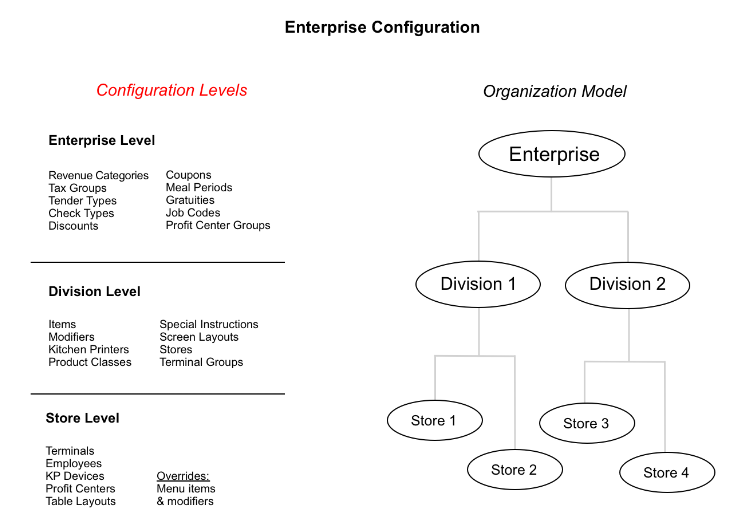
An InfoGenesis POS enterprise consists of a three-tier configuration and reporting business model: enterprise, division, and store levels. These levels are designed to provide standardization and security of configuration and flexible reporting capability across multiple profit centers or outlets.
Enterprise
Enterprise is where financial and business configuration is defined. Any configuration done at this level affects all levels below it. The following list is a sample of items configured at the enterprise level: check types, tenders, discounts and coupons, job codes, taxes, meal periods, revenue classes, and categories.
Division
Each enterprise must have at least one division assigned to it. Depending on the business requirements many divisions can be configured under an enterprise. Divisions are where items and supporting configuration are defined. Any configuration done at this level affects all levels below it. The following list is a sample of items configured at the division level: items, product classes, modifiers, stores, order screens, and special instructions.
Store
Each division must have at least one store assigned to it. Depending on the business requirements, many stores can be configured under each division. Stores are where configurations specific to physical locations are defined. The following is a sample of items configured at the store level: employees, profit centers, table layouts, terminals, and kitchen printer devices.
While items and modifiers are configured at the division level, it is possible to create store level items and modifiers that are only accessible to an individual store when using the IGCM. Permission can be granted to back-office users of an individual store to be able to create or modify these special store-level items. This allows for regional or store division level items. While the store will not have permission to modify screen layouts, containers may be used for displaying all store specific items.
Miscellaneous Considerations
All numeric identifiers for configuration elements (such as item ID, product class ID, revenue category ID, and so on) must be unique within the enterprise. Even though items are not shared between divisions, the numeric identifier is still unique throughout enterprise. For example, if item number 101 is used in division 1, it cannot be used in division 2. To be able to reuse the same item ID, either share the actual item by having all stores that need access to that item within the same Division or create totally separate enterprises where it is possible to reuse all IDs.
ID numbers for all configuration elements can be reused by creating a new enterprise with the following exceptions: Profit Center IDs, Employee IDs, and Terminal IDs. These are required to be unique across an entire POS server regardless of how many enterprises exist on that server.
Each level inherits the configuration from the levels above it. For example, in the diagram following, Store 4 inherits the configuration elements from division 2 and the enterprise. Elements configured at the enterprise level are for all divisions and stores within that enterprise. All items and other division related elements are applied to (or available for use in) all stores within that division.
The diagram below illustrates the relationship between the three levels with examples of the type of data that is configured at each level. The list of data in each level is by no means complete. For a complete list, refer to the Configuration Specifics section of this documentation.